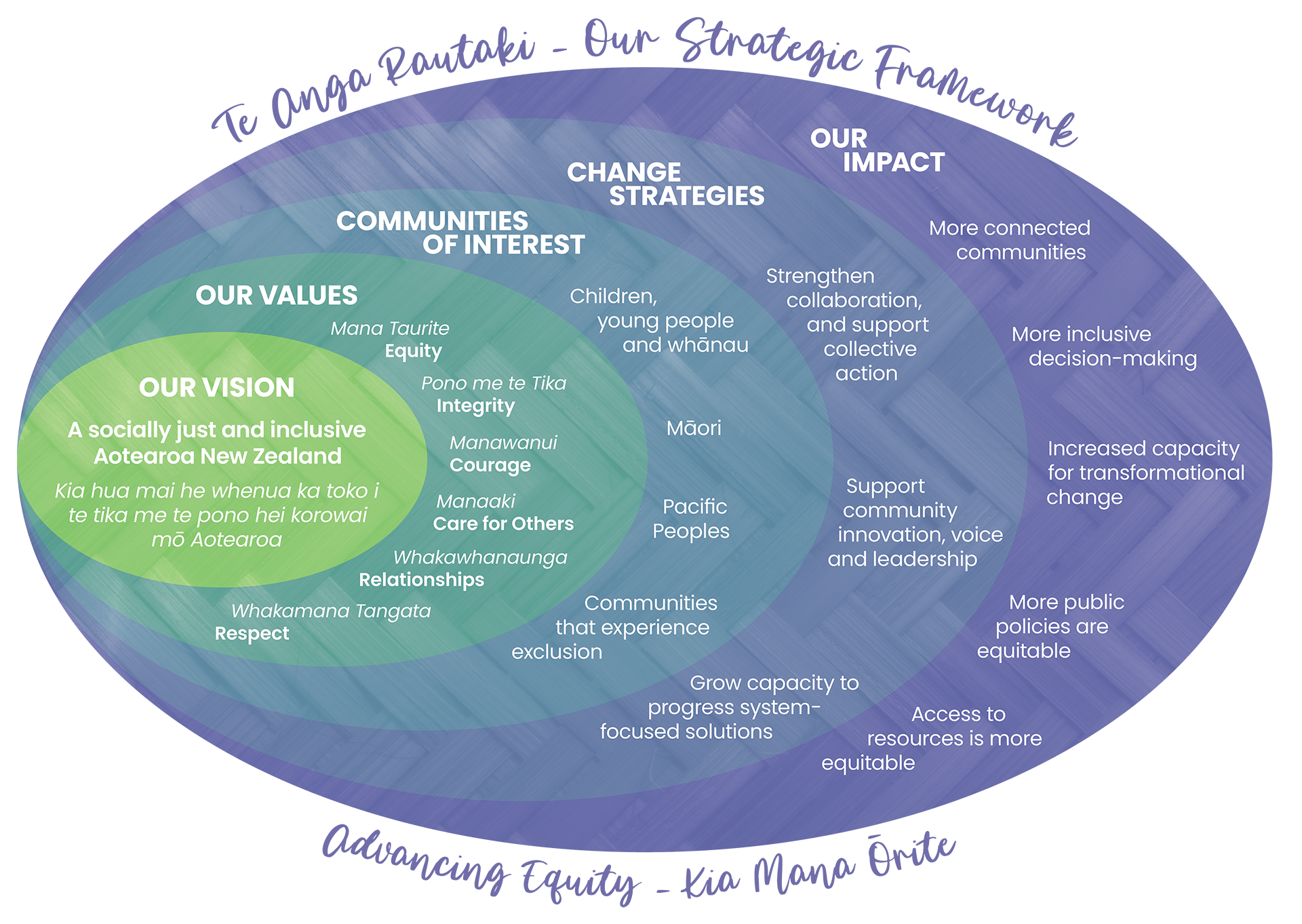


Te Anga Rautaki
J R McKenzie Trust Strategy 2021-2030

Executive Summary
This is the story of the journey we have taken to develop our strategy, Te Anga Rautaki.
Since its establishment over 80 years ago, the J R McKenzie Trust has endeavoured to uphold the mana and mahi of the organisations and communities it supports. The Trust has a unique identity and giving philosophy that was steered by Sir John and Sir Roy McKenzie and has been further shaped by subsequent generations of the McKenzie family. This identity is a valued legacy that provides the Trust with a clear guide for the way that we view, shape, and practise our philanthropy.
Our strategy, Te Anga Rautaki, is the latest expression of the Trust’s giving philosophy, one that is grounded in respect for the organisations and communities we support. It has been developed to ensure that the work of the Trust is responsive to the current and emerging needs of the communities we serve. The strategic priority is working and investing in ways that advance equity through transformational change and system focused solutions.
Advancing equity means addressing underlying causes of inequity and exclusion.
Transformational change describes a major positive shift or change that makes a big difference to people’s quality of life.
Systems focused solutions are designed to fundamentally change the mechanisms and structures that cause the system to operate in a particular manner.
We work with ngā kaikōkiri who are leaders of social change in their communities. We are focused on four pou/communities of interest that often intersect:
Children, young people and whānau
Māori
Pacific Peoples
Communities that experience exclusion.
By gaining a deeper understanding some of the root causes of inequity and exclusion, and pinpointing key opportunities or levers for change, we identified three change strategies that are strongly aligned to the Trust’s vision:
Strengthen collaboration and support collective action
Support community innovation, voice and leadership
Grow capacity to progress system-focused solutions.
Through the adoption of these change strategies, we are seeking the following positive impacts:
More connected communities
More inclusive decision-making
Increased capacity for transformational change
More public policies are equitable
Access to resources is more equitable.
Te Anga Rautaki is designed to support the Trust to continue to strive towards our vision:
Kia hua mai he whenua ka toko i te tika me to pono hei korowai mō Aotearoa / A socially just and inclusive Aotearoa New Zealand.
Introduction
“We are aiming to demonstrate courageous leadership as we set out our strategic plans for the next decade.”
At the Conference of Rotary Clubs in Palmerston North in 1940, Sir John Robert McKenzie made a ‘munificent gift’ to the people of Aotearoa New Zealand. Through a donation of £100,000 plus one-third of the McKenzie’s Stores’ annual profits, the J R McKenzie Trust was born. His plan to “establish a Trust which will prove of benefit to the community, not only at present, but in the years to come,” was progressed and realised by Sir Roy McKenzie, another catalyst of change who unassumingly saw himself as a “community volunteer”.
We are always inspired by the many creative thinkers using their passion and skills to care for others and catalyse change for good throughout Aotearoa New Zealand. These unique attributes were held by Sir John when he established the Trust over 80 years ago and continued when Sir Roy took the helm. Both led the Trust with integrity and courage, while seeking to support equitable outcomes for New Zealanders, and it’s this we aspire to.
Like Sir John and Sir Roy, we are aiming to demonstrate courageous leadership as we set out our strategic plans for the next decade. We must ensure that the Trust remains relevant now and in the future as the social and philanthropic landscapes continue to evolve.
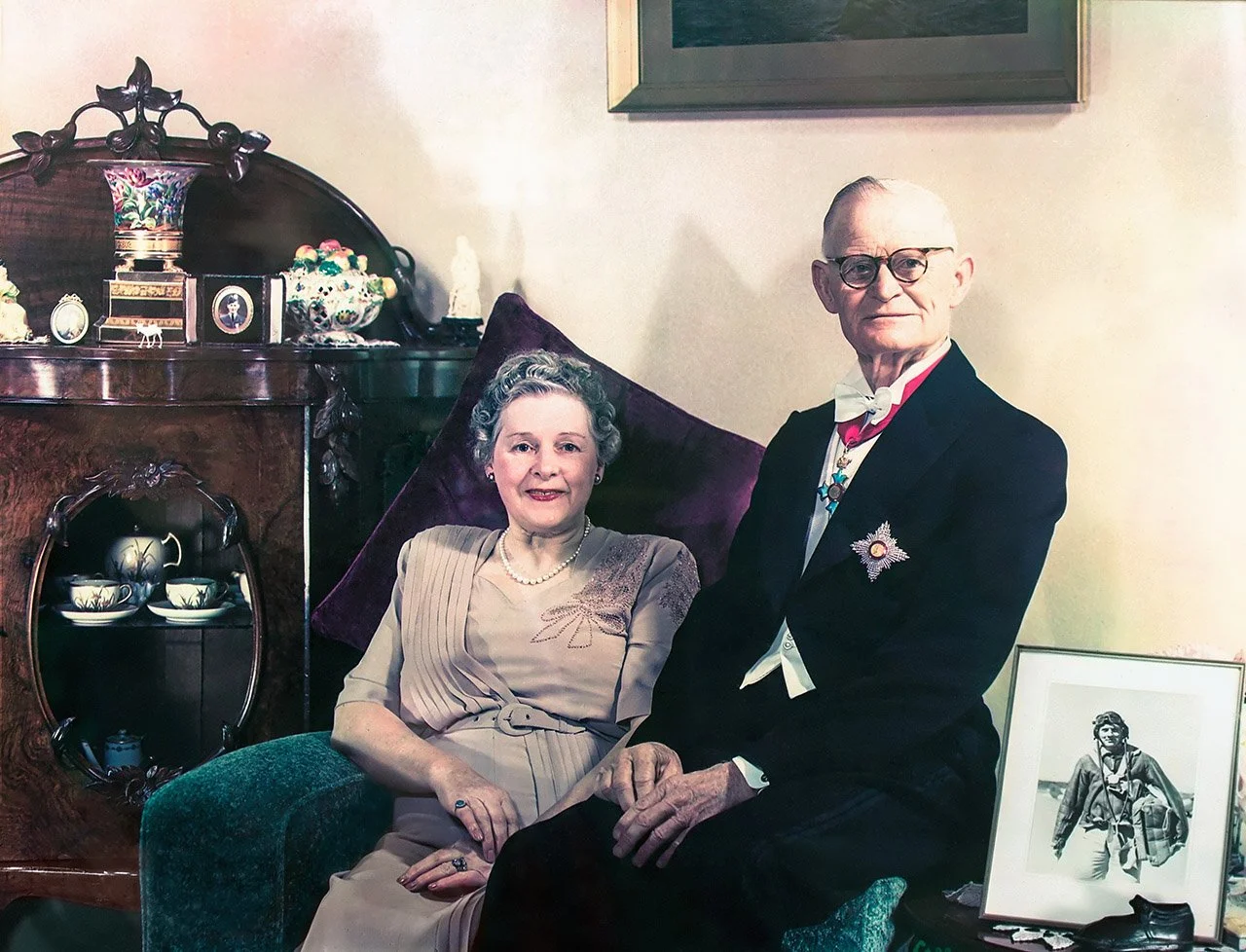
Sir John and Lady May McKenzie
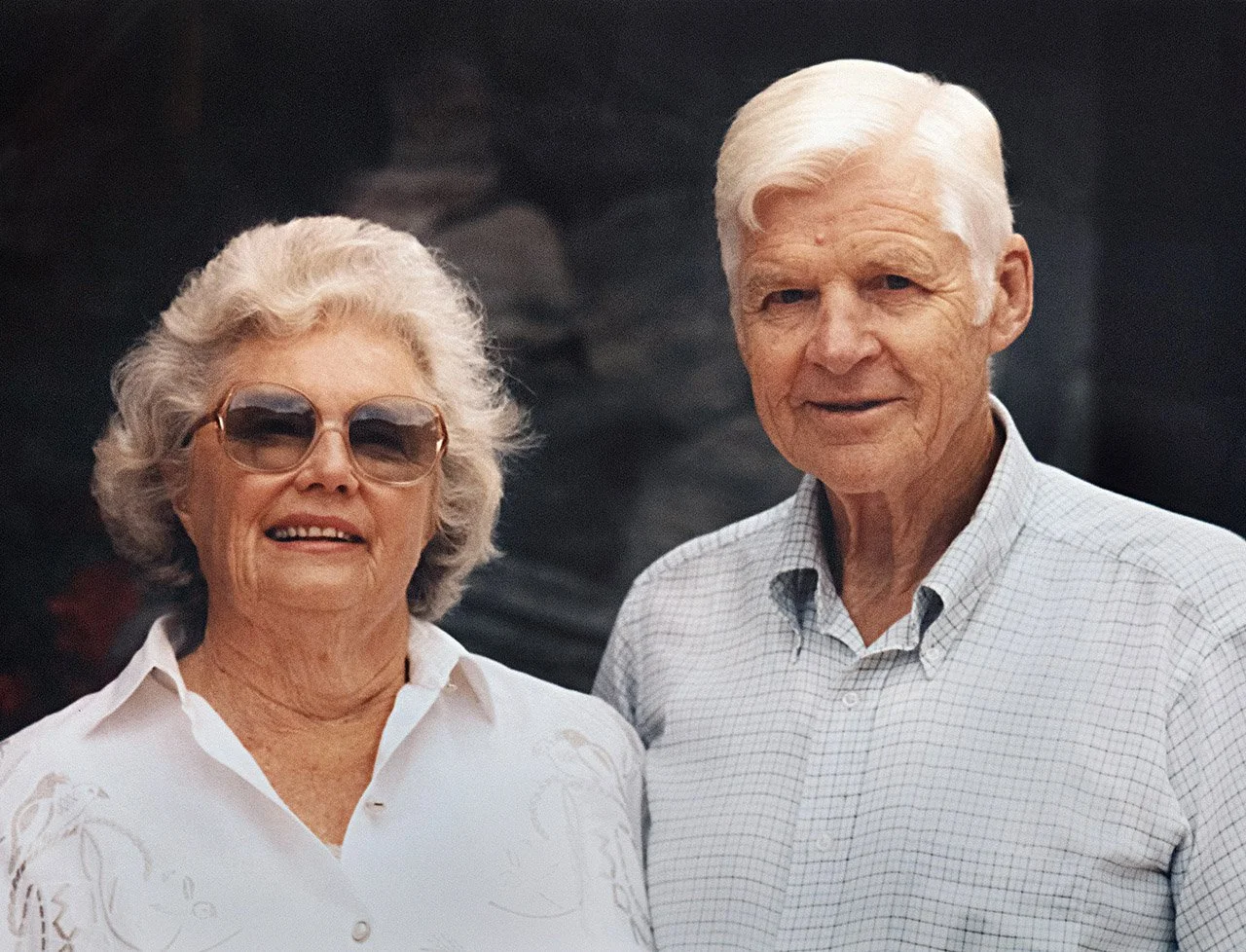
Sir Roy and Lady Shirley McKenzie
Identity and Values
The Trust has a unique identity grown from the vision of Sir John to establish a trust that could help improve the quality of life for New Zealanders and address disadvantage, particularly for children. The unique attributes of our identity align with our values, which form the bedrock of the Trust and were our touchstones during the development of Te Anga Rautaki.
|
The Trust’s unique attributes |
How this is valued by ngā kaikōkiri and/or leverages unique impact |
How these align with the Trust’s values |
|---|---|---|
|
The Trust’s clearly stated and practised social justice focus |
|
Mana Taurite | Equity Increasing equity and empowering all voices |
|
The Trust’s efforts to influence systems change |
|
|
|
Manawanui | Courage Bold new thinking and courageous conversations |
||
|
The Trust’s visionary, innovative and courageous approaches |
|
|
|
The Trust’s flexible and relational approach |
|
Whakawhanaunga | Relationships Authentic, enduring relationships Manaaki | Care for Others Open, warm and kind Whakamana Tangata | Respect Respectful and mana enhancing Pono me te Tika | Integrity Open, honest and ethical |
The generous and courageous actions of Sir John and Sir Roy are continued by the current generation of family members, who seek ongoing engagement with the Trust’s mission and who have outlined their own aspirations for the Trust to:
be purposeful, bold and innovative.
be responsive to communities and empower whānau and community self-determination.
continue engaging with issues that achieve multi-generational impact.
build connections and partnerships that support impact, learning and growth.
The family’s legacy and continued vision are the roots from which the Trust’s present-day impact is able to grow.
Vision, Strategic Priority, and Communities of Interest
Te Anga Rautaki is designed to support the Trust to continue to strive towards our vision: Kia hua mai he whenua ka toko i te tika me to pono hei korowai mō Aotearoa / A socially just and inclusive Aotearoa New Zealand.
Te Anga Rautaki’s priority is working and investing in ways that advance equity through transformational change and systems focused solutions.
Advancing equity means addressing underlying causes of inequity and exclusion. It means shifting the conditions that hold inequities in place, that prevent people from fulfilling their potential.
Transformational change describes a major positive shift or change that makes a big difference to people’s quality of life.
Systems focused solutions are designed to fundamentally change the mechanisms and structures that cause the system to operate in a particular manner. In both obvious and subtle ways, systems often work better for some groups in society than others, compounding the situation negatively for those who already face the biggest challenges.
We work with ngā kaikōkiri who are leaders of social change in their communities. We are focused on four pou/communities of interest that often intersect:
Children, young people and whānau
We will prioritise opportunities to achieve intergenerational outcomes for children, young people and their family and whānau. We will focus on initiatives that advance intergenerational opportunities.
Māori
We will prioritise opportunities to support tino rangatiratanga and achieve outcomes for Māori. We will focus on initiatives that are Māori-led and that respond to/further the aspirations of Māori.
Pacific Peoples
We will prioritise opportunities to achieve outcomes for Pacific Peoples. We will focus on supporting initiatives that are Pacific-led and that respond to/further the aspirations of Pacific Peoples.
Communities that experience exclusion
We will prioritise opportunities to support the inclusion and wellbeing of communities that experience exclusion. We will focus on initiatives that ensure excluded communities have a voice and equitable access to opportunities.
Root Causes and Levers for Change
An evidence review was undertaken to inform Te Anga Rautaki. Here are some things we learned.
Some of the root causes of inequity and exclusion
The intergenerational impacts of colonisation.
Racism, discrimination, stigma, and bias.
A lack of visibility, representation, and decision-making power.
Systems, policies, and services that don’t reflect real lives, needs and different world views.
Exclusion from adequate income, which further drives exclusion from other opportunities such as housing or education.
Exclusion from participation and opportunities e.g. employment or civic participation.
Exclusion from services and social supports.
The opportunities or levers for change for J R McKenzie Trust
The importance of focusing on issues of equity and social justice.
Focusing on systems change by addressing underlying issues holding problems in place.
Sharing power with communities and wielding institutional voice to influence greater change.
Ensuring philanthropic practice is more responsive to tangata whenua and indigenous practices.
The benefits of adopting a range of funding approaches – i.e. staying adaptable and using learning to inform decision-making.
Change Strategies
Through the review process it became clear that:
All four of JRMT’s communities of interest are interconnected and share many of the same drivers of inequity and exclusion.
Advancing equity requires transformational change at all levels – from ground up (local, community-led change), to top down (political and institutional change).
Investing in transformational change challenges funders to consider how their own ways of working constrain or enable change.
From the evidence review, three change strategies were identified as being strongly aligned to the J R McKenzie Trust’s vision.
In all change strategies, we are interested in understanding how the community has had input into the proposed programme or initiative.
Support community innovation, voice and leadership
Support communities to try out ideas with potential to enhance wellbeing and strengthen identity, connection, and access to opportunities.
Support initiatives that enable community voices and stories to inform solutions.
Grow community leadership.
Support programmes, systems and policies that are designed with community, especially with those less visible or that may be excluded from decision-making.
Strengthen collaboration and support collective action
Strengthen and enable collaboration where ngā kaikōkiri see potential to work together on solutions.
Strengthen and build the capacity of networks, coalitions and partnerships that enable systemic thinking and action.
Support more connected and collective efforts to shift the conditions holding problems in place.
Grow capacity for system-focused solutions
Strengthen readiness, skills and capacities of ngā kaikōkiri to think and act systemically.
Support ngā kaikōkiri to develop new and known (Indigenous) solutions or practices that address issues of social justice and advance equity and inclusion.
Support changemakers, disrupters and influencers to advance their skills, capacity and influence.
Develop communities of practice to share learning and support ngā kaikōkiri to achieve impact.
Signs of Progress and the Impact We Seek
The Signs of Progress we are looking for
The Impact we are Seeking
Principles of Practice and How We Fund
Our funding partnerships with ngā kaikōkiri are relational, flexible, strategic and mana-enhancing.
Principles of Practice
Our agreed principles of practice describe the roles that we can play as partners alongside ngā kaikōkiri to achieve impact:
Fund Whakakotahi
Investing in ngā kaikōkiri and forming mana-enhancing partnerships with themAdvocate Manaaki
Advocating for the work of ngā kaikōkiriConvene Ahurutanga
Making time and space to bring ngā kaikōkiri and others together to collaborateInnovate Auaha
Encouraging and enabling innovation to address complex challengesLearn Ako
Learning to grow collective knowledge and ideas, and building capacity for transformational change
How We Fund
J R McKenzie Trust is a social justice funder. Our focus on advancing equity means targeting those experiencing the greatest inequity, exclusion and disadvantage.
Since 2024, we practice relational funding. This means our funding is allocated via partnerships and collaboration with community organisations. We may also fund organisations that have been referred to us by other funders. We are a non-contestable funder - we don't take applications.
We are willing to engage in new and challenging spaces and invest in more connected outcomes. Our desire to support transformational change means enabling those at the forefront of change and social innovation efforts in Aotearoa New Zealand. We are interested in how transformational change can play out in grassroots communities (local systems) and via regional, national, institutional and political systems.
Given that it is difficult for one group to achieve transformational change at a large scale alone, supporting creative collaboration, and uplifting and supporting leaders of social change is important.
Additionally, the Trust recognises its own power to influence change, through a range of non-funding roles such as convening, advocating, evaluating, sharing learning, and amplifying the voices of ngā kaikōkiri.
The Trust wants to demonstrate equity through its own practice, by building mana-enhancing relationships of respect, care and equity with ngā kaikōkiri.
In Conclusion
Te Anga Rautaki builds on the J R McKenzie Trust’s legacy of showing aroha to the vulnerable; the Rotarian values of service and fairness; the Trust’s boldness; a strengths-based, community-centred approach; learning from bright spots; and supporting transformational change impacts for marginalised communities. The Trust has never shied away from trying different approaches and seeks to be open and intuitive in its mahi.
Over the past eight decades, the Trust has supported ngā kaikōkiri as they work towards achieving their aspirations. It has been an honour and a privilege to collaborate with them on their journeys and we hope that our small contribution has assisted their progress and success. We have been consistently humbled by their dedication towards making a meaningful difference, often while facing unrelenting challenges. We will continue to seek to use our position and power to amplify their voice and influence positive change. Without nurturing these strong and successful relationships, our mahi would lose some of its mana.
It’s from this standpoint, that we look forward to the achievements of the next ten years and beyond.
“Do not follow where the path may lead; go instead where there is no path and leave a trail.” – A favourite quote of Sir Roy McKenzie